Most landlords do their bookkeeping once a year, in March, with a shoebox of receipts and twelve bank statements. It works until the year it doesn’t: a missed repair receipt, a security deposit counted as income, a mortgage payment deducted in full.
Rental property bookkeeping doesn’t need accounting software or an accountant’s training. It needs a separate place for the money, categories that match your tax return, a short monthly routine, and records you can find later. This guide covers all four for landlords with one to twenty units, using the IRS rules that decide what counts as income and what you can deduct.
If you want the spreadsheet itself, our landlord spreadsheet template lays out the columns. This post is about the process behind it.
Rental bookkeeping at a glance
| Task | How often | Why it matters |
|---|---|---|
| Run all rental money through one account | Set up once | Keeps personal spending out of your records |
| Categorize every transaction by property and Schedule E line | Weekly or monthly | Your tax return becomes a total, not a reconstruction |
| Save the receipt or invoice with each expense | As you pay | Receipts are what prove a deduction |
| Reconcile to the bank statement | Monthly | Catches missed and duplicate entries |
| Log rental mileage | Each trip | Car deductions need a record made at the time |
| Review profit or loss by property | Quarterly | Shows which units earn money and feeds estimated taxes |
| Close the year and hand off to Schedule E | Annually | Adds depreciation, Form 1098, and 1099 filings |
Step 1: Separate the rental money
Open a checking account, and ideally a credit card, used only for your rentals. No federal rule requires it for an individual landlord, but it is the single biggest time saver in rental bookkeeping. Every rent deposit and every expense lands in one place, and your bank statement becomes a first draft of your books.
It also protects your deductions. A charge on your personal card for a hardware-store run is harder to defend than the same charge on an account that only pays for rental costs. And if you plan to claim the QBI deduction for rental property under the IRS safe harbor, separate books for each rental enterprise are one of its requirements.
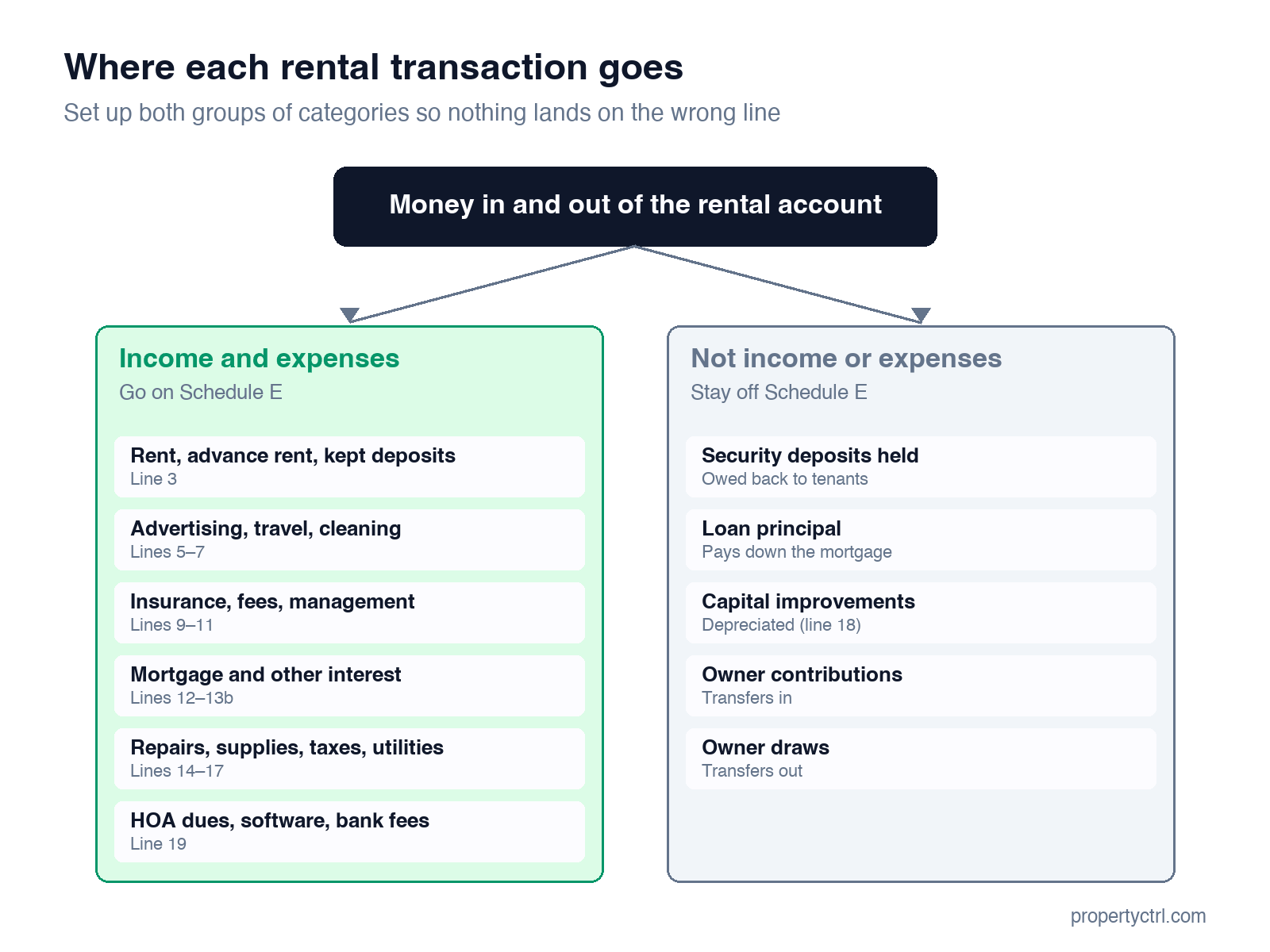
Two kinds of money move through that account without being income or expenses:
- Owner contributions: money you move in from personal savings to cover a repair or a slow month.
- Owner draws: profit you move out to yourself.
Record both as transfers. Neither one belongs on Schedule E.
Security deposits need their own line in your books, and in some states their own bank account. State laws regulate where deposits are held and whether they earn interest for the tenant, so check your state’s rules before you deposit one.
Step 2: Use categories that match Schedule E
Your rental income and expenses end up on Schedule E, one column per property. If your bookkeeping categories use the same lines, your tax return is a set of totals instead of a sorting job. These are the income and expense lines on the 2026 draft form:
| Category | Schedule E line | Examples |
|---|---|---|
| Rents received | 3 | Monthly rent, advance rent, kept security deposits |
| Advertising | 5 | Listing fees, signs |
| Auto and travel | 6 | Mileage, parking, tolls |
| Cleaning and maintenance | 7 | Lawn care, pest control, turnover cleaning |
| Commissions | 8 | Leasing agent fees |
| Insurance | 9 | Landlord policy premiums |
| Legal and professional fees | 10 | Attorney, accountant, tax preparation for the rental |
| Management fees | 11 | Property manager fees |
| Mortgage interest | 12 | Interest on the rental’s mortgage (not principal) |
| Other interest | 13a, 13b | Vehicle loan interest (13a), credit card interest on rental costs (13b) |
| Repairs | 14 | Fixing a leak, a lock, a broken window |
| Supplies | 15 | Light bulbs, filters, small consumables |
| Taxes | 16 | Property taxes on the rental |
| Utilities | 17 | Utilities you pay as landlord |
| Other | 19 | HOA dues, software, bank fees |
Line 18, depreciation, is not a bookkeeping category: it is figured once a year from the cost of the building and improvements. Our Schedule E line-by-line guide covers each line in detail.
Add four categories that are not expenses, so these transactions have somewhere to go besides the wrong line:
- Security deposits held: money you owe back to tenants.
- Loan principal: the part of each mortgage payment that pays down the loan.
- Capital improvements: new roofs, additions, and other work you depreciate.
- Owner contributions and draws.
Step 3: Record on the cash method
Most individual taxpayers use the cash method: you report income in the year you actually or constructively receive it, and deduct expenses in the year you pay them. Rent credited to your bank account on December 31 is income for that year, even if you don’t look at the account until January.
For bookkeeping, that means you record the date money actually moved, not the date on an invoice or the month the rent covers. It also means uncollected rent is never a deduction. You did not report it as income, so there is nothing to write off.
Transactions landlords often record wrong
Most bookkeeping errors come from a short list of transactions that look like one thing and are taxed as another. The rules below come from IRS Publication 527 unless noted.
| Transaction | How to record it |
|---|---|
| Security deposit received | Not income if you plan to return it. Record it as a deposit held. |
| Security deposit kept for damage or unpaid rent | Income in the year you keep it |
| “Deposit” to be used as the last month’s rent | Advance rent: income when you receive it |
| Advance rent (January’s rent paid in December) | Income in the year you receive it, whatever period it covers |
| Tenant pays a bill that is yours and deducts it from rent | Record the full rent as income and the bill as your expense |
| Tenant does work instead of paying rent | Income at the fair market value of the work, and the same amount as an expense if the work is deductible |
| Tenant pays you to cancel the lease | Rental income when received |
| Monthly mortgage payment | Split it: interest is an expense and principal reduces the loan. The escrow part is not an expense yet; record taxes and insurance when the lender pays them, from your escrow statement |
| Loan fees such as mortgage commissions and recording fees | Not interest; they are added to the property’s basis |
Repairs or improvements?
A repair keeps the property in working order and is deducted in the year you pay it. An improvement makes the property better, restores it, or adapts it to a new use, and is depreciated over years. A patched roof is a repair; a new roof is an improvement. Record improvements in their own category with the invoice, because you will need the cost and date for depreciation. Our rental property depreciation guide explains how improvements are written off.
For smaller purchases, the IRS de minimis safe harbor lets landlords without an applicable financial statement (such as audited financials, which most small landlords don’t have) deduct items costing up to $2,500 per invoice or item instead of depreciating them, such as a new refrigerator. Two conditions matter for your books:
- You must expense those amounts in your books under a consistent policy that exists at the start of the year.
- You elect the safe harbor each year by attaching a statement to your timely filed tax return. Once you elect it, it applies to every qualifying purchase that year.
Mileage
Car expenses need records made at or near the time of the trip: the date, the miles, the destination, and the business purpose, plus your total miles for the year. For 2026 the standard mileage rate is 72.5 cents a mile through June 30 and 76 cents a mile from July 1.
Not every trip counts. Publication 527 says travel between your home and a rental property is generally nondeductible commuting unless your home is your principal place of business. Keep the log anyway, and ask your tax preparer which trips qualify in your situation. Our rental property tax deductions checklist covers what else you can write off.
Stop sorting bank statements every spring. PropertyCtrl records rent and expenses by property and category as they happen, with the receipt attached, so your Schedule E totals are ready when you are. Try it free for 14 days, no credit card required.
A monthly bookkeeping routine that takes an hour
Bookkeeping is easier in twelve small sessions than one big one. Once a month:
- Record every transaction from the rental account and card: date, amount, property, category, and a note on anything unusual.
- Attach the receipts. Photograph paper receipts the day you get them; digital copies are fine as long as they stay legible and you can retrieve them.
- Reconcile. Your recorded balance should match the bank statement. If it doesn’t, you missed or duplicated a transaction.
- Check the rent roll. Who paid, who paid late, and which deposits you are holding.
- Update the mileage log if you didn’t record trips as you went.
Once a quarter, review profit or loss for each property. That is when you notice a unit whose costs are creeping up, and it is the number you need if you make estimated tax payments. Our guide to how rental income is taxed explains when estimated payments apply.
At year end
- Collect Form 1098 from your lender and match the interest to your books.
- File Forms 1099-NEC or 1099-MISC if required. For payments made in 2026, the threshold rose from $600 to $2,000 per payee. Collecting a Form W-9 before you pay a contractor makes this easy.
- Update your depreciation schedule with any improvements placed in service during the year.
- Total each category by property. Those totals are your Schedule E.
How long to keep rental property records
How long to keep a record depends on the period of limitations for the return it supports, which is the time the IRS has to assess more tax and you have to claim a refund. According to the IRS guidance on keeping records:
| Record | Keep it for |
|---|---|
| Income and expense records, receipts, bank statements | Generally 3 years from the date you filed the return |
| Same records, if you claim a credit or refund after filing | 3 years from filing or 2 years from paying the tax, whichever is later |
| Same records, if you left out income of more than 25% of the gross income on the return | 6 years |
| Records for a bad debt deduction or a worthless securities loss | 7 years |
| Property records: purchase documents, improvements, depreciation | Until the limitations period ends for the year you sell or dispose of the property |
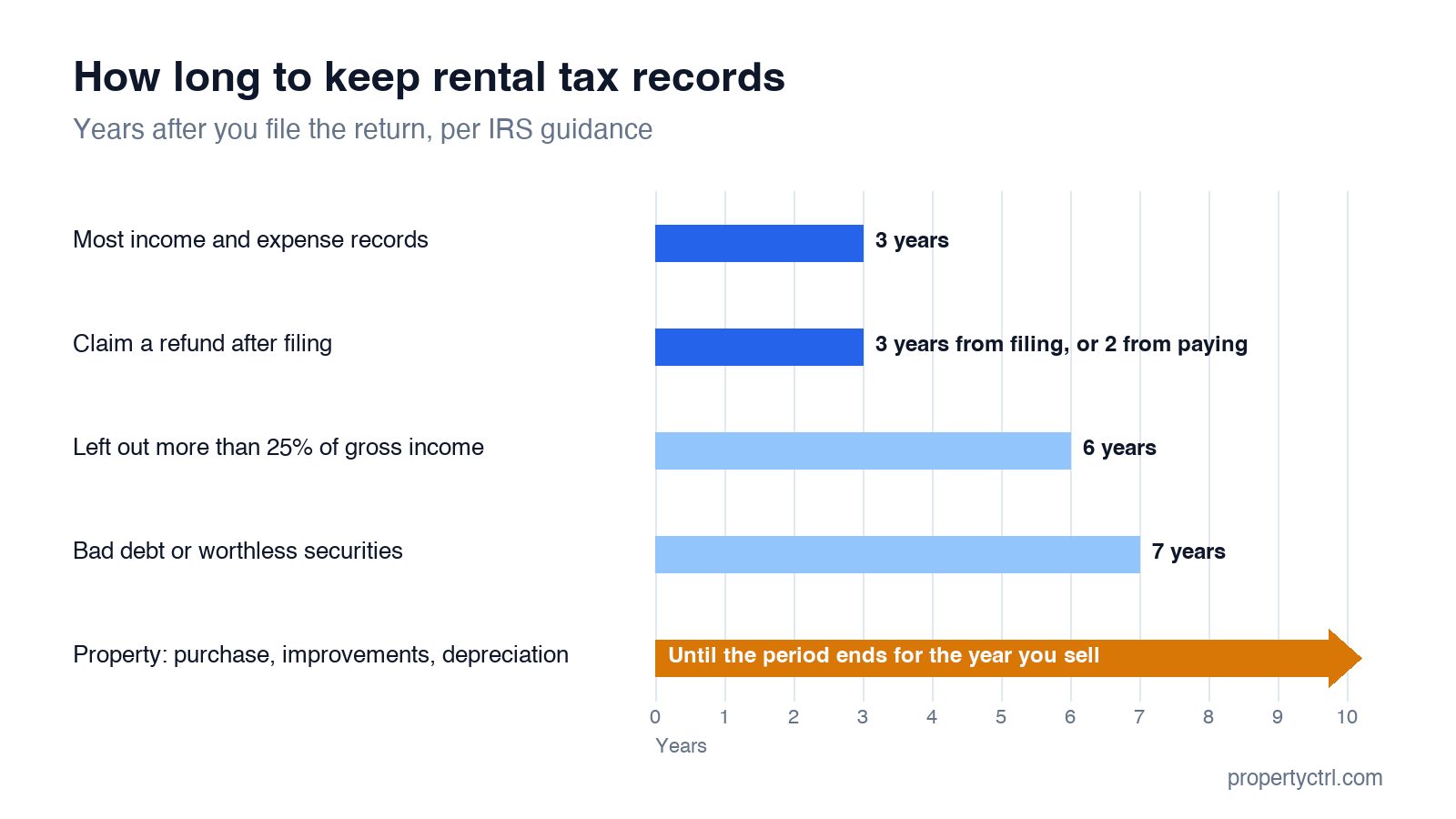
The last row is the one that matters most for landlords. Records of what you paid for a property and every improvement you made support depreciation for decades and the gain when you sell. If you trade into a new property through a like-kind exchange, keep the old property’s records too, until the limitations period runs out for the year you dispose of the new one. Lenders and insurers may ask you to keep some records longer.
Spreadsheet or software?
A spreadsheet works for one or two units if you keep the monthly routine. It gets harder as you add properties: categories drift, receipts live in a separate folder, and reconciling by hand takes longer each month. Our landlord spreadsheet template gives you the layout and the signs it is time to move on.
Property management software takes over the parts that are easy to skip: recording rent as it arrives, tagging expenses to the right property and category, and keeping receipts with the transaction. Whichever you use, the steps above are the same.
Your books should be finished before tax season starts. PropertyCtrl keeps rent, expenses, receipts, and maintenance for each property in one place, built for landlords with 1–20 units. Start your free 14-day trial, no credit card required.
Frequently Asked Questions
Do I need a separate bank account for my rental property?
No federal rule requires one for an individual landlord, but it is strongly recommended. It keeps personal and rental transactions apart, makes your bank statement a starting point for your books, and makes deductions easier to support. Some states require security deposits to be held in a separate account, so check your state’s rules.
Is a security deposit rental income?
Not when you receive it, if you plan to return it at the end of the lease. If you keep part or all of it because the tenant broke the lease terms, the amount you keep is income in that year. A deposit that will be used as the final month’s rent is advance rent and is income when you receive it.
What accounting method should landlords use?
Most individual landlords use the cash method: income is recorded when received and expenses when paid. It matches how most landlords think about their money and is what most individual taxpayers use.
How long should landlords keep receipts?
Generally three years from the date you file the return they support. Keep records about the property itself, such as the purchase and improvements, until the limitations period ends for the year you sell it, because they support depreciation and your gain on the sale.
Can I deduct the whole mortgage payment on a rental?
No. Only the interest is a rental expense. The principal portion pays down the loan. Money paid into escrow is not deductible until the lender pays the taxes or insurance from it; your escrow statement shows those payments, and Form 1098 shows the interest.
This article is for informational purposes only and is not legal or tax advice. Laws change and vary by city and county — consult a licensed attorney or tax professional in your state for advice on your situation.
PropertyCtrl Team
Helping landlords and property managers simplify their operations with expert guidance on property management, legal compliance, and financial optimization.