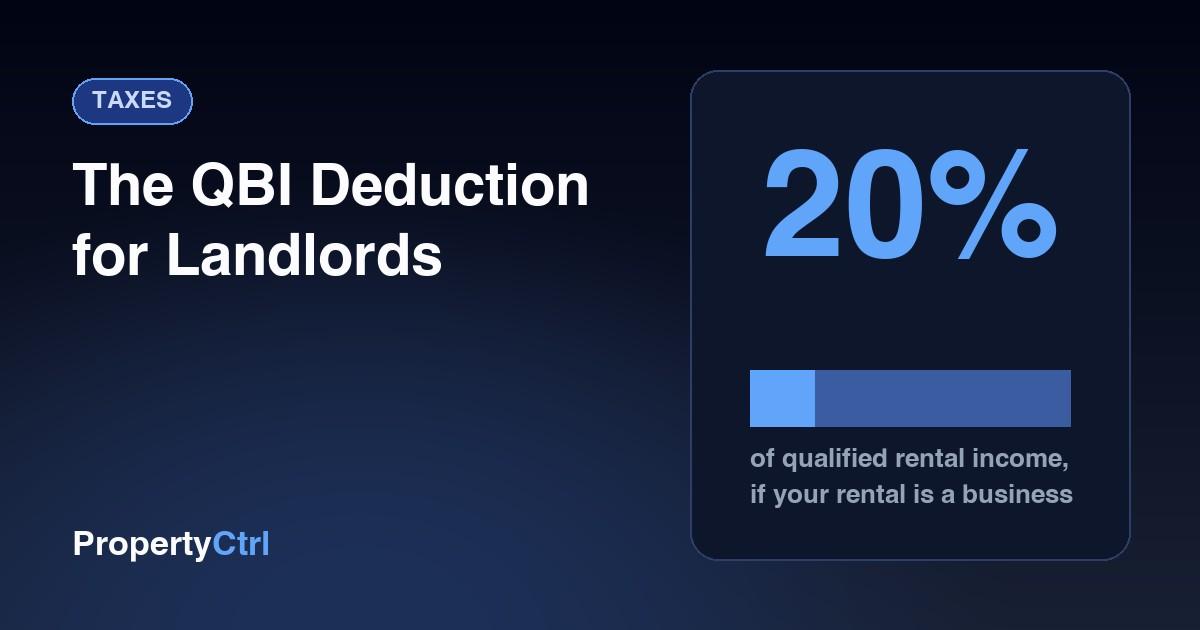
The qualified business income (QBI) deduction lets owners of pass-through businesses deduct up to 20% of their business profit. For a landlord, that can mean deducting a fifth of your net rental income, on top of the expenses and depreciation you already claim on Schedule E.
The catch is that rental income does not qualify automatically. The QBI deduction on rental property is only available when your rental activity counts as a trade or business. This guide explains how to clear that bar for the 2026 tax year (the return you file in early 2027), what the deduction is worth, and how to claim it.
The 2026 dollar amounts come from IRS Revenue Procedure 2025-32 and the draft 2026 Form 8995 instructions, which can change before release; check the official Form 8995 page before you file. For everything else you can write off, see our rental property tax deductions checklist.
The QBI deduction for landlords at a glance
| Rule (tax year 2026) | What it means for landlords |
|---|---|
| Deduction | Up to 20% of qualified business income from your rentals |
| Who qualifies | Rentals that are a trade or business, either under the IRS 250-hour safe harbor or the general Section 162 standard |
| Overall cap | 20% of taxable income before the QBI deduction, minus net capital gain |
| Simple calculation (Form 8995) | Taxable income of $201,750 or less ($403,500 married filing jointly) |
| Wage and property limit phases in | $201,750 to $276,750 ($403,500 to $553,500 married filing jointly) |
| Above the phase-in range | Limited to the greater of 50% of W-2 wages paid, or 25% of W-2 wages plus 2.5% of the business’s qualified property (UBIA) |
| New $400 minimum deduction | Requires at least $1,000 of QBI from businesses you materially participate in; passive rental income does not count |
| Forms | Form 8995 or Form 8995-A, plus a safe harbor statement each year you use the safe harbor |
Married couples filing separately use a $201,775 threshold and a $276,775 top of the phase-in range. The deduction is taken whether you itemize or take the standard deduction, and it does not reduce your adjusted gross income.
What changed for 2026
The QBI deduction was written into the law in 2017 with an expiration date: it was set to end after 2025. The One Big Beautiful Bill Act, signed in July 2025, rewrote that expiration provision (Section 70105 of the law), so the deduction continues for 2026 and later years. Three other changes take effect for 2026:
- A wider phase-in range. The wage and property limit now phases in over $75,000 of taxable income ($150,000 on a joint return), up from $50,000 ($100,000 joint).
- Higher thresholds. The income level where the phase-in starts rose to $201,750 ($403,500 married filing jointly) with the annual inflation adjustment.
- A $400 minimum deduction. Taxpayers with at least $1,000 of QBI from businesses they materially participate in get a deduction of at least $400. Most rental income is passive, so most landlords will not get it; more on that below.
Does rental income count as qualified business income?
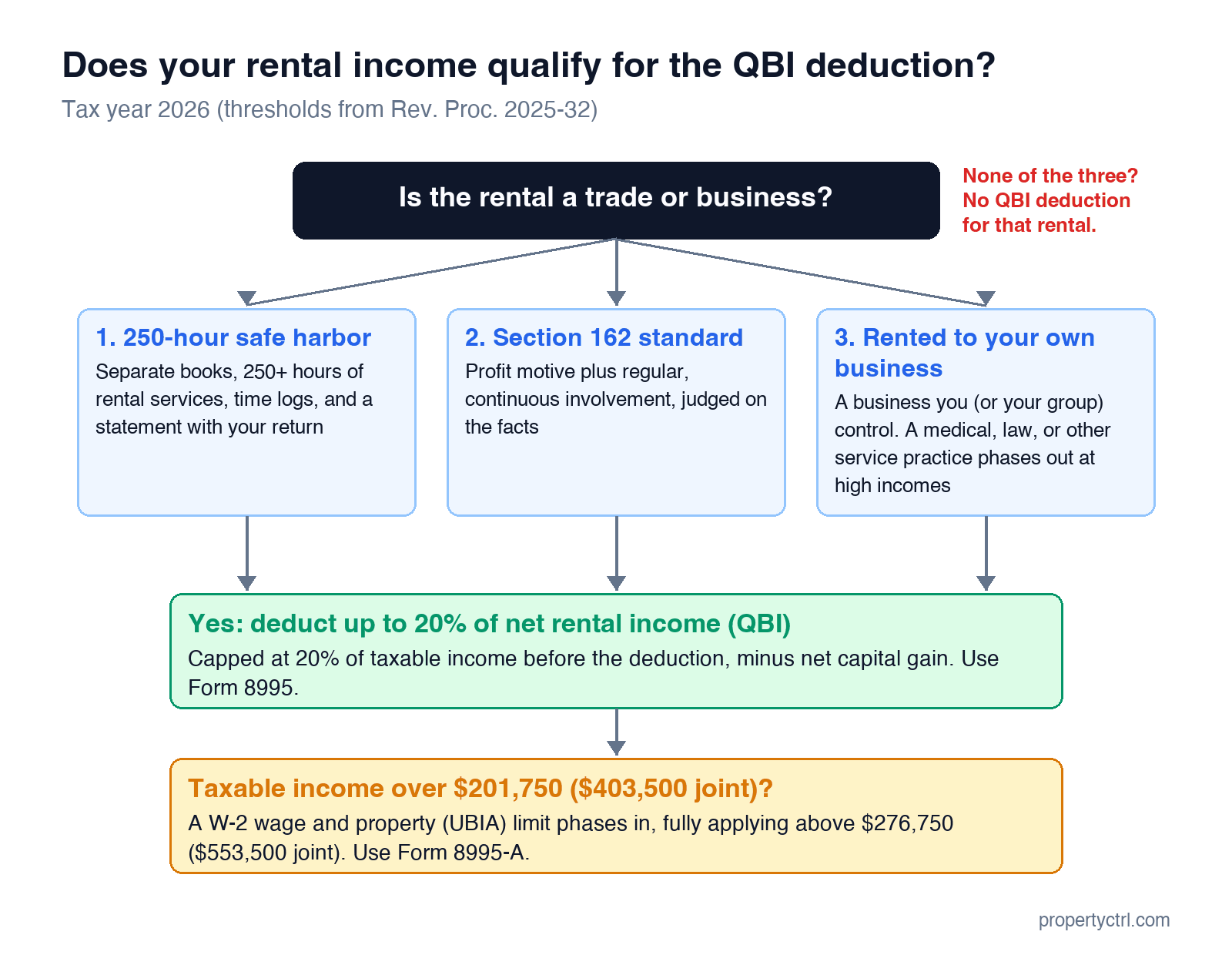
Only when the rental is a trade or business. Owning a property and collecting rent, on its own, may be an investment rather than a business. There are three ways a rental can qualify:
- The rental real estate safe harbor. Revenue Procedure 2019-38 treats a rental real estate enterprise as a trade or business if you meet four requirements, including 250 hours of rental services a year. This is the most predictable route, and it is covered in detail in the next section.
- The general trade-or-business standard. Under Section 162, an activity is a trade or business if your primary purpose is income or profit and you are involved with continuity and regularity. A rental that misses the safe harbor can still qualify this way.
- Renting to your own business. Renting or licensing property to a trade or business that you (or a group that includes you) commonly control is treated as a trade or business for the QBI deduction. One exception matters for professionals: if the tenant is a specified service business, such as your medical, law, accounting, or consulting practice, and there is 50% or more common ownership, the rental is treated as part of that service business. Its QBI deduction then phases out above $201,750 of taxable income ($403,500 joint) and is gone above $276,750 ($553,500 joint), no matter how much building basis you have.
If the rental qualifies, your QBI from it is generally your net rental income as it is used in figuring your taxable income: rents minus the deductible expenses on Schedule E, including mortgage interest and depreciation. Gains taxed as capital gains, such as most of the profit when you sell the property, are not QBI. Our guide to how rental income is taxed walks through how that net figure is built.
The 250-hour safe harbor, requirement by requirement
Revenue Procedure 2019-38 sets out the safe harbor. You choose it each year, and you must meet all of its requirements for that year:
- Separate books and records for each rental real estate enterprise. If an enterprise has several properties, you can keep income and expense statements for each property and consolidate them.
- 250 or more hours of rental services. An enterprise that has existed for less than four years needs 250 hours every year. Once it has existed for at least four years, it needs 250 hours in any three of the five consecutive years ending with the current year.
- Contemporaneous records, such as time reports or logs, showing the hours of all services, a description of the services, the dates, and who performed them.
- A statement attached to your return for each year you rely on the safe harbor (see “How to claim it,” below).
What counts toward the 250 hours
The hours do not all have to be yours. Rental services performed by owners, employees, agents, and independent contractors all count, so the time your property manager or handyman spends on the enterprise is included. For work done by employees or contractors, your records can be a description of the services, the amount of time they generally spend on them, and their time or payment records.
| Counts as rental services | Does not count |
|---|---|
| Advertising the property for rent | Arranging financing |
| Negotiating and signing leases | Shopping for or buying property |
| Verifying tenant applications | Studying and reviewing financial statements or reports |
| Collecting rent | Making improvements that must be capitalized |
| Daily operation, maintenance, and repairs, including buying materials and supplies | Travel to and from the property |
| Managing the real estate and supervising employees and contractors |
The line between repairs and improvements matters here as much as it does on Schedule E: the hours a contractor spends replacing a roof are improvement hours and do not count, while the hours spent fixing a leak do. Our rental property depreciation guide covers which work gets capitalized.
Grouping properties into one enterprise
You can treat each property as its own enterprise, or combine all similar properties into one. Combining is how many small landlords reach 250 hours: three single-family rentals that each take about 90 hours a year clear the bar together but not separately. The rules:
- Residential and commercial properties cannot be in the same enterprise.
- A building with both residential and commercial units can be one enterprise of its own, or split into residential and commercial parts.
- Once you combine properties, new similar properties join the group, and you cannot split it apart again while you use the safe harbor.
- You must hold each property directly or through a disregarded entity, such as a single-member LLC. Partnerships and S corporations can use the safe harbor at the entity level.
Properties the safe harbor excludes
- Real estate you also use as a residence under the vacation-home rules, such as a property you stay in for part of the year.
- Property rented under a triple net lease, where the tenant pays the taxes, fees, insurance, and maintenance in addition to rent and utilities.
- Property rented to a business you commonly control. (That rental generally qualifies for the QBI deduction anyway, under the self-rental rule above.)
If you do not meet the safe harbor
Missing the safe harbor does not rule out the deduction. The IRS says rental real estate that misses it can still be treated as a trade or business if it meets the Section 162 standard. That test turns on the facts: how many properties you have, the type of rental, and how regularly and continuously you are involved. A portfolio of long-term rentals you actively manage is a stronger case than one property whose tenant handles everything. Document your involvement as the safe harbor would require, and talk with your tax preparer before claiming the deduction this way.
Keeping separate books for each rental is half the safe harbor. PropertyCtrl tracks rent, expenses, and maintenance for each of your properties, so the records the IRS asks for already exist when you file. Try it free for 14 days, no credit card required.
How much is the QBI deduction worth?
Below the threshold: the simple calculation
If your 2026 taxable income before the QBI deduction is $201,750 or less ($403,500 married filing jointly), the math has two steps. Take 20% of your QBI, then compare it with 20% of your taxable income (figured before the QBI deduction) minus net capital gain. Your deduction is the smaller of the two.
Example. A married couple owns three single-family rentals that they treat as one residential enterprise under the safe harbor. Between their own work and their property manager’s, they log 290 hours of rental services in 2026. After expenses and depreciation, the rentals show net income of $24,000 on Schedule E. Their taxable income before the QBI deduction is $150,000, which includes $2,000 of qualified dividends.
| Step | Amount |
|---|---|
| 20% of QBI ($24,000 × 20%) | $4,800 |
| Income cap: 20% of ($150,000 − $2,000) | $29,600 |
| QBI deduction (the smaller amount) | $4,800 |
| Tax saved in the 22% bracket ($4,800 × 22%) | $1,056 |
Their taxable income drops to $145,200, still inside the 2026 married-filing-jointly 22% bracket ($100,800 to $211,400), so each dollar of the deduction saves 22 cents. Because they are under the threshold, they use the simpler Form 8995.
Above the threshold: the wage and property limit
Above $201,750 of taxable income ($403,500 joint), a second limit phases in. Once you are past the top of the phase-in range, $276,750 ($553,500 joint), your QBI component for each business cannot exceed the greater of:
- 50% of the W-2 wages the business paid, or
- 25% of those W-2 wages plus 2.5% of the business’s UBIA of qualified property.
Most small landlords have no employees, so the first option is zero and everything rides on UBIA, the unadjusted basis immediately after acquisition. For a rental, that is generally the basis of the building and other depreciable property on the day it was placed in service, before any depreciation. Land is not depreciable, so it is left out. A property stops counting once its depreciable period ends, which is the later of 10 years after you placed it in service or the last full year of its recovery period (27.5 years for a residential rental building). Improvements count as separate property with their own UBIA.
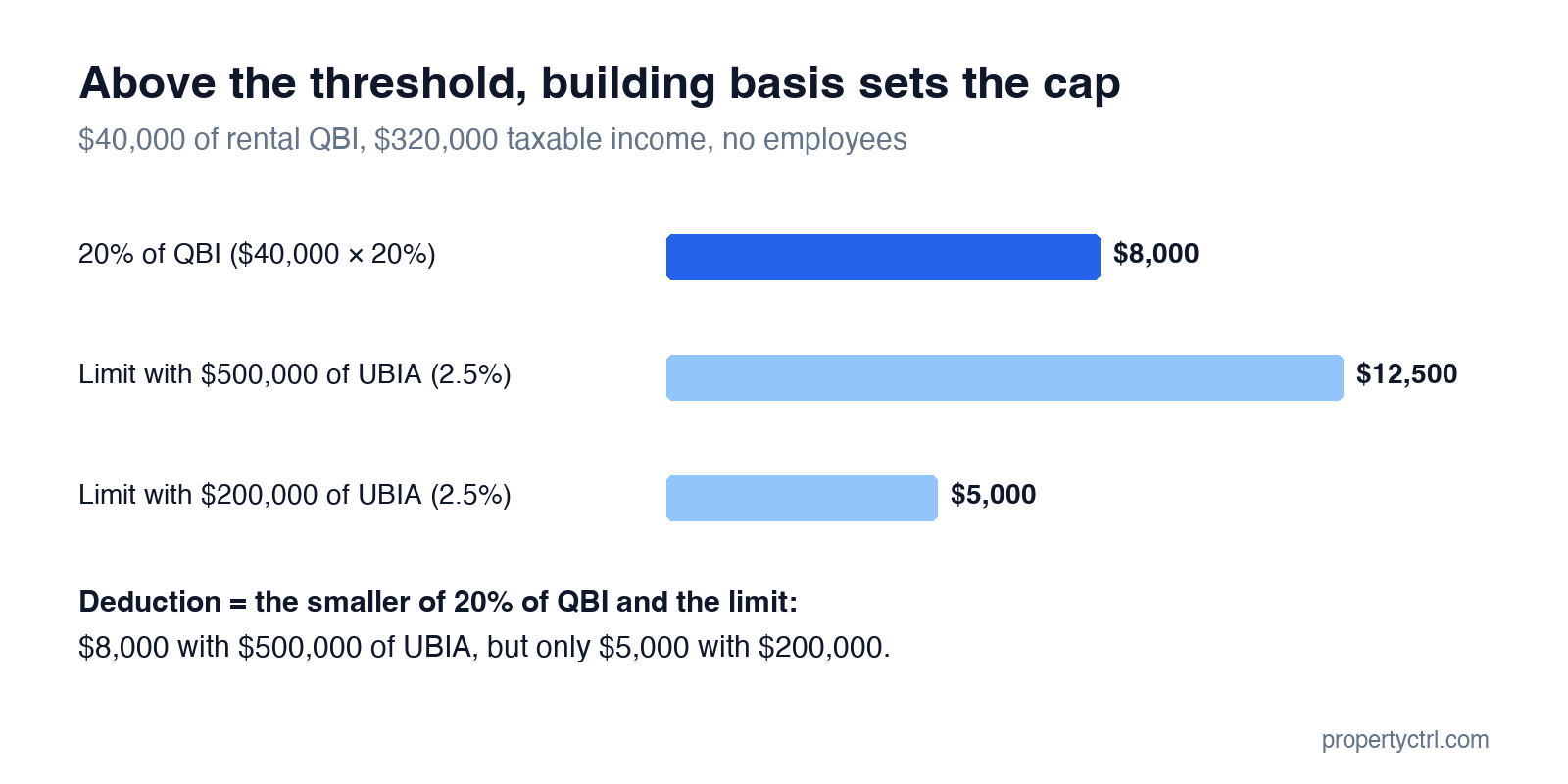
Example. A single landlord has $320,000 of taxable income before the QBI deduction, above the top of the phase-in range, so the full limit applies. Their rentals, treated as one enterprise, produce $40,000 of QBI. They have no employees. The buildings they own, not counting land, have a combined UBIA of $500,000, and all are still within their depreciable periods.
| Step | $500,000 of UBIA | If UBIA were $200,000 |
|---|---|---|
| 20% of QBI ($40,000 × 20%) | $8,000 | $8,000 |
| Wage and property limit (2.5% of UBIA; no W-2 wages) | $12,500 | $5,000 |
| QBI component (the smaller amount) | $8,000 | $5,000 |
| Income cap: 20% of $320,000 (no capital gains) | $64,000 | $64,000 |
| QBI deduction | $8,000 | $5,000 |
Between the threshold and the top of the phase-in range, only part of the reduction applies. Form 8995-A does that calculation for you; anyone above the threshold uses Form 8995-A instead of Form 8995.
What happens when your rental shows a loss
Rental losses interact with the QBI deduction in three ways:
- Losses reduce your other QBI. If you have more than one qualified business, a loss from a qualifying rental that is allowed this year reduces the QBI from the others. If your qualified businesses net to a loss overall, you get no QBI deduction this year (unless you have qualified REIT dividends or PTP income), and the net loss carries forward to reduce QBI next year.
- Suspended losses wait. A loss suspended by the passive activity rules is not part of QBI in the year it is suspended. It enters QBI in the later year when it is finally allowed, and reduces your QBI that year.
- Old losses never count. Losses and deductions from before 2018 are not included in QBI, even when they are released in a later year.
So a rental that showed a loss in its early years, often because of depreciation, can shrink your QBI deduction years later when that suspended loss is released.
The new $400 minimum deduction and landlords
Starting in 2026, a taxpayer whose aggregate QBI from active qualified businesses is at least $1,000 gets a QBI deduction of at least $400. A business is active only if you materially participate in it, and the draft instructions are explicit that passive activity income does not count.
Rental activities are generally passive under the tax code, however many hours you put in, unless you qualify as a real estate professional and materially participate. So for most landlords, the minimum deduction will not apply to rental income.
How to claim the QBI deduction on rental income
- Report the rental on Schedule E as usual. The QBI deduction does not change Schedule E; see our Schedule E line-by-line guide for that part.
- Figure the deduction on Form 8995 or 8995-A. Use Form 8995 if your taxable income before the deduction is at or below the threshold; otherwise use Form 8995-A. If you rely on the safe harbor, list each enterprise the way your statement identifies it, such as “Enterprise 1.”
- Attach the safe harbor statement to a timely filed original return for each year you use the safe harbor. It must describe each property in each enterprise, including its address and whether it is residential or commercial; describe properties bought or sold during the year; and state that the requirements of Revenue Procedure 2019-38 have been met.
- Keep the time records with your tax files. You do not file them, but they must be available if the IRS asks.
The deduction then reduces your taxable income on Form 1040. It is a deduction from taxable income, not from adjusted gross income, and you can take it whether or not you itemize, according to the IRS’s QBI deduction page.
Records to keep
- A time log with dates, hours, the work done, and who did it, kept as the work happens rather than rebuilt at tax time
- Property manager and contractor invoices that describe their services
- Income and expense records for each property, plus settlement statements and depreciation schedules (you need them to work out UBIA)
Your QBI deduction starts with clean numbers for each property. PropertyCtrl keeps rent, expenses, and maintenance requests organized property by property, so your net rental income is ready for Schedule E and Form 8995. If you are still on a spreadsheet, our landlord spreadsheet template shows what to capture. Start a free 14-day trial when you are ready to stop tracking it by hand.
Frequently Asked Questions
Can landlords take the QBI deduction?
Yes, if the rental activity is a trade or business. You can establish that by meeting the IRS safe harbor in Revenue Procedure 2019-38, by meeting the general Section 162 trade-or-business standard, or by renting to a business you commonly control. A property held only as an investment, without the regular involvement of a business, does not qualify.
Do I need 250 hours to get the QBI deduction on rental property?
No. The 250-hour rule is part of the safe harbor, which gives you a predictable answer. A rental that misses it can still qualify if it is a trade or business under Section 162, but that depends on the facts and is harder to prove.
Does my property manager’s time count toward the 250 hours?
Yes. Rental services performed by agents, employees, and independent contractors count, as well as your own. Keep a description of the services, the time generally spent on them, and payment records for the people you hire.
Is the QBI deduction reported on Schedule E?
No. Schedule E reports your rental income and expenses. The QBI deduction is figured separately on Form 8995 or Form 8995-A and then reduces your taxable income on Form 1040. It does not change your adjusted gross income.
Do I need an LLC to claim the QBI deduction on rental income?
No. Individuals who own rentals in their own names can claim it. If you use the safe harbor, you must hold each property directly or through a disregarded entity such as a single-member LLC; partnerships and S corporations apply the safe harbor at the entity level.
This article is for informational purposes only and is not legal or tax advice. Laws change and vary by city and county — consult a licensed attorney or tax professional in your state for advice on your situation.
PropertyCtrl Team
Helping landlords and property managers simplify their operations with expert guidance on property management, legal compliance, and financial optimization.